The Hidden Power of Presentation Skills: Why Great Speakers Stand Out Everywhere
A powerful presentation is not just about speaking English. It is about knowing how to make your words work for you.
Have you ever wondered why some people instantly sound confident in an interview, command attention during a group discussion, or leave a lasting impression after a presentation?
The answer is often not just their knowledge.
It is their presentation and communication skills.
A person may have excellent ideas, strong academic qualifications, and good command of English. But if they do not know how to structure their thoughts, emphasize the right words, handle pauses, respond to questions, or engage an audience, their message may lose its impact.
This is exactly why professional presentation skills have become such an important part of effective communication.
Presentation Skills Are Much More Than Public Speaking
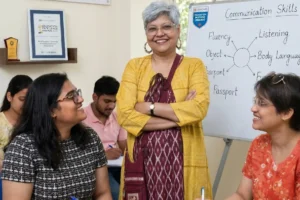
At Educare Institute, we believe that a presentation is not simply about standing in front of an audience and speaking.
It is about learning the art and science of communication.
A strong presenter learns:
- Where to pause
- Which words to emphasize
- How to soften a statement
- How to make an important point memorable
- How to handle unexpected questions
- How to recover gracefully after getting stuck
- How to restate an idea without losing confidence
- How to maintain audience engagement
- How to use tone, pace and body language effectively
These are small techniques, but together they can create a remarkable difference in the way a person communicates.
From Presentation Skills to Interview Confidence
The real beauty of presentation training is that its benefits do not remain limited to presentations.
The same skills become extremely useful in job interviews, group discussions, meetings, seminars, debates, workplace conversations and public speaking.
Imagine being asked an unexpected question in an interview.
Instead of panicking, you learn to pause, organise your thought, and respond confidently.
Imagine losing your sentence during a group discussion.
Instead of freezing, you know how to restate your thought and continue naturally.
Imagine having to convince someone about an idea.
Instead of simply giving information, you know how to use emphasis, repetition and rhetorical techniques to make your message more persuasive.
That is the real power of presentation training.
The Professional Techniques Behind Powerful Communication
Professional presentation training introduces learners to several practical communication tools.
1. Tripling
Tripling is a powerful rhetorical technique in which three related words, phrases or ideas are used together to create rhythm and emphasis.
It makes communication more memorable and gives the speaker’s message greater impact.
2. Machine Gunning
Machine gunning helps a speaker deliver a series of words or ideas with energy and controlled rhythm.
When used correctly, it can make speech sound more dynamic and engaging.
3. Rhetorical Techniques
Rhetorical techniques help speakers move beyond ordinary information-sharing.
They can make a statement more thought-provoking, persuasive and memorable.
A well-placed rhetorical question, for example, can immediately make the audience think rather than simply listen.
4. Softening
Professional communication is not always about sounding strong.
Sometimes, the speaker needs to sound polite, diplomatic and considerate.
Softening helps us express opinions, disagreement or suggestions without sounding unnecessarily harsh.
This is especially valuable in interviews, meetings and professional conversations.
5. Emphasis
Knowing what to emphasize and where to emphasize it can completely change the impact of a sentence.
The right word, spoken with the right stress, can communicate meaning much more effectively.
6. Repetition
Strategic repetition helps important ideas stay in the listener’s mind.
The objective is not to repeat unnecessarily, but to repeat with purpose.
7. Restating
What happens when a speaker gets stuck?
A confident communicator does not panic.
They learn to restate the sentence, reorganize the thought and move forward.
This is an extremely valuable skill because real-life communication rarely goes exactly according to a script.
Ayushi’s Presentation: A Practical Example
A recent professional presentation by our student Ayushi on “Psychology of Decision Making” beautifully demonstrates how these skills come together.
Her presentation showed fluency, confidence, effective word choice and a good understanding of professional presentation techniques.
She also demonstrated the use of rhetorical techniques, tripling, question handling, emphasis and softening.
Most importantly, her performance reflects an important principle we emphasise at Educare Institute:
Skills become powerful when they are practised, not merely studied.
Every presentation gives a learner an opportunity to discover what they already do well and what they can refine further.
Even small areas such as speaking pace, sentence endings, pronunciation or vocal clarity can be improved through conscious practice.
And that is where real growth begins.
Why Presentation Practice Matters
You cannot become a confident communicator by simply learning communication rules.
You have to use them.
You have to stand up.
You have to speak.
You have to make mistakes.
You have to face questions.
You have to experience pauses.
And then you have to try again.
With every presentation, the fear reduces, the confidence increases and the speaker gradually becomes more natural.
This transformation is particularly important for students who initially hesitate to speak in front of others.
A presentation is therefore not merely an academic assignment.
It can become a confidence-building experience.
The Bigger Goal: Becoming an Impactful Communicator
At Educare Institute, our objective is not to create students who can simply speak English.
Our objective is to help learners become clear, confident and impactful communicators.
Because communication is needed everywhere.
In an interview.
In a group discussion.
In a classroom.
In a business meeting.
In a presentation.
In a leadership role.
And even in everyday conversations.
When presentation skills improve, communication becomes more structured, confident and purposeful.
And when communication improves, opportunities often become easier to approach.
Final Thought
Your knowledge may open the door.
But your ability to communicate can determine how confidently you walk through it.
So, if you want to become a better speaker, don’t just learn what to say.
Learn how to say it.
Learn how to pause.
Learn how to emphasize.
Learn how to soften.
Learn how to engage.
Learn how to handle questions.
Learn how to recover when you get stuck.
And most importantly, keep practising.
Because great speakers are rarely born.
They are developed—one presentation at a time.
At Educare Institute, we don’t just teach English. We develop confident communicators.
Learn. Practise. Present. Grow.

You may also like